Draft: Zain's voice pass pending. Adapted from a LinkedIn post; he reviews before this publishes.
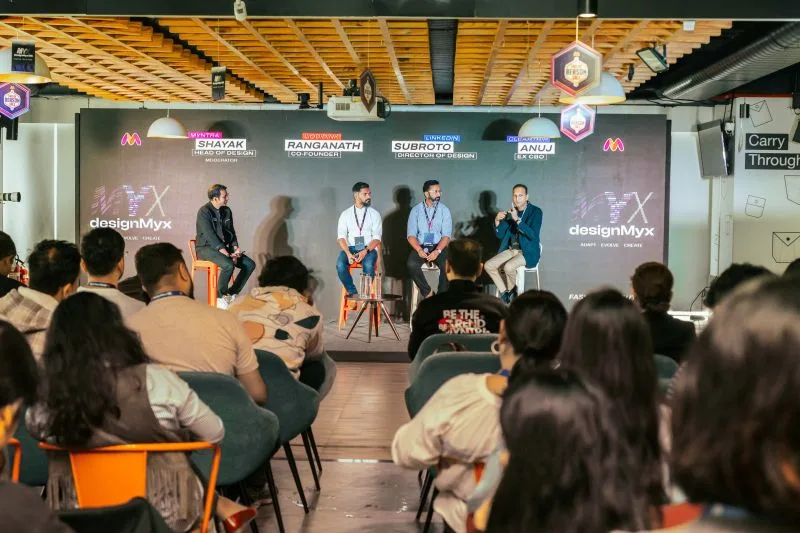
I attended Myntra Design MYX'25 recently, and one theme was unmissable: the definition of "what a designer does" is expanding fast. Huge credit to Shayak Sen and the Myntra Design team. The branding, visuals, and motion design were genuinely top-tier.
Five things I took away
-
Generative UI (Parikshit Deshmukh). Why should AI reply with text when it can reply with an interface? We're used to scarce content; now we're flooded with AI text that's hard to consume. His product, Thesys, converts intent into interactive, contextual interfaces: progressively revealing what you need, when you need it, instead of another wall of paragraphs.
-
AI is like electricity (panel: Shayak Sen, Subroto Bagh, Anuj Rathi, Ranganath Krishnamani). A general enabler that needs designers to build the useful things on top of it. Our skills have to stretch both directions: forward into business strategy, backward into tech and multimodal. When building is easy, taste and curation become your biggest asset.
-
Your design system needs a brain (Ishan Nahata, Razorpay). My favorite technical takeaway. Razorpay turned their Blade design system into an MCP: a plugin that reads a sketch or screenshot and suggests the exact components to use. It kills newbie overwhelm and cuts search time to seconds. Built by a product designer, not a dev.
-
Curiosity is a creative multiplier (Sumit Bedi). Move from "imagine if…" to "check out what I built." Don't let ideas die in your head. Use AI to make them real instantly.
-
Storytelling at scale (Sourajit Sengupta). Razorpay produces ad films at 80% less cost and 4x the speed using AI. The lesson wasn't "it's a shortcut." It takes deep narrative control. AI is the camera; you're still the director.
The reflection
We're moving from designing artifacts to designing intelligence: designers building plugins, training MCPs, directing AI films. That's not a hypothetical shift anymore; it's what the room was actually doing.